


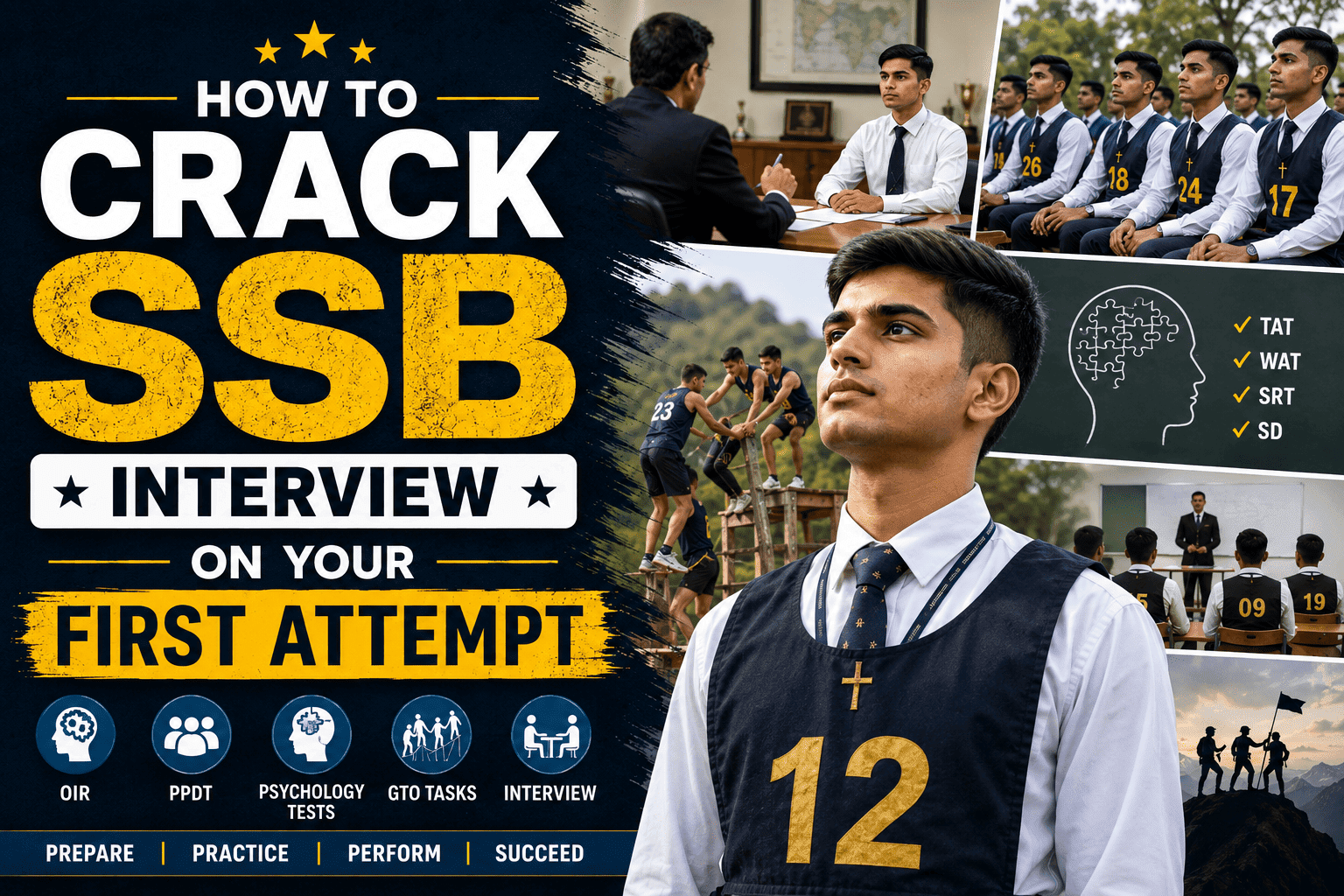
How to Crack SSB Interview on Your First Attempt: The Complete Preparation Guide
Can you crack the SSB interview on your first attempt? Absolutely – but not by memorising a list of “perfect” answers.
The Services Selection Board (SSB) is different from a conventional competitive examination. You are not simply being tested on how much you can remember. The selection process uses multiple assessment techniques to understand your personality, reasoning, behaviour, communication, teamwork and potential for becoming an officer.
That is why many academically strong candidates struggle at SSB, while candidates with average-looking profiles sometimes perform exceptionally well.
The difference often comes down to preparation, self-awareness and the ability to perform naturally under pressure.
If you are preparing for your first SSB, this guide will help you understand exactly what to prepare, how to prepare, what mistakes to avoid and how to build a practical SSB preparation strategy.
Quick Answer: To crack SSB on your first attempt, understand the complete SSB selection process, practise OIR and PPDT, prepare systematically for psychology tests, improve communication and group skills, stay updated with current affairs, know your personal profile thoroughly, maintain physical fitness and most importantly – develop genuine Officer Like Qualities instead of trying to fake them.
What Is the SSB Interview?
The Services Selection Board interview, commonly called the SSB interview, is a comprehensive selection process for candidates aspiring to become officers in the Indian Armed Forces.
Unlike a written examination where candidates primarily answer questions on a syllabus, SSB uses different assessment techniques to evaluate a candidate holistically.
For UPSC defence entries, the published SSB procedure is divided into Stage I and Stage II.
Stage I includes:
- Officer Intelligence Rating (OIR) Tests
- Picture Perception and Description Test (PP&DT)
Candidates who clear Stage I proceed to Stage II.
Stage II includes:
- Interview
- Group Testing Officer (GTO) Tasks
- Psychology Tests
- Conference
UPSC states that candidates are assessed by the Interviewing Officer, Group Testing Officer and Psychologist, with the candidate’s performance considered holistically rather than through separate weightage for individual tests.
This is one of the most important things to understand before beginning your SSB interview preparation.
You are not preparing for four unrelated tests. You are preparing to demonstrate your overall potential across different situations.
Can You Crack SSB Interview on Your First Attempt?
Yes.
But there is no magic formula, shortcut or guaranteed answer that can ensure an SSB recommendation.
The better question is:
What can I do to give myself the best possible chance of being recommended on my first attempt?
The answer is systematic preparation.
A first-time candidate should focus on five broad areas:
1. Test Familiarity
Know what OIR, PPDT, Psychology, GTO and Interview involve.
2. Self-Awareness
Know your education, family, hobbies, achievements, failures, strengths, weaknesses and goals.
3. Communication
Learn to express your thoughts clearly without trying to sound artificial.
4. Personality Development
Build habits related to responsibility, teamwork, initiative, discipline and decision-making.
5. Consistent Practice
Practise under realistic conditions rather than simply reading about SSB.
Understanding the SSB Selection Process
Before you start searching for SSB interview questions, understand the complete journey.
Stage I: Screening
The screening stage is your first major challenge.
OIR Test
The Officer Intelligence Rating test assesses verbal and non-verbal reasoning ability.
You may encounter questions involving:
- Analogy
- Classification
- Series
- Coding and decoding
- Logical reasoning
- Mathematical reasoning
- Verbal reasoning
- Non-verbal reasoning
- Spatial relationships
The key is not merely solving questions.
The key is solving them accurately within limited time.
PPDT
The Picture Perception and Description Test evaluates how you perceive and interpret a situation and how effectively you communicate your thoughts in a group setting.
A practical PPDT preparation strategy involves:
- Observing the picture carefully.
- Identifying relevant characters and circumstances.
- Creating a realistic storyline.
- Maintaining a logical sequence.
- Presenting your ideas clearly.
- Participating constructively in the discussion.
Don’t turn every PPDT picture into an action movie.
A simple, logical and realistic story is usually more convincing than an exaggerated one.
How to Prepare for the OIR Test
If you want to improve your OIR performance, practise regularly instead of studying occasionally.
Step 1: Identify Your Weak Areas
Take a diagnostic test.
Find out whether you struggle with:
- Verbal reasoning
- Non-verbal reasoning
- Number series
- Coding-decoding
- Analogy
- Classification
- Speed
Step 2: Practise With a Timer
OIR preparation is not only about knowing the solution.
It is about developing speed and accuracy together.
Step 3: Analyse Your Mistakes
After every practice session, ask:
- Why did I get this question wrong?
- Did I misunderstand the question?
- Did I make a calculation mistake?
- Did I spend too much time?
- Was I guessing unnecessarily?
This turns practice into improvement.
How to Prepare for PPDT
PPDT is one of the areas where first-time candidates often become nervous.
Don’t.
A good PPDT preparation strategy is based on observation + imagination + logical storytelling + communication.
When you see the picture, don’t immediately start writing.
First observe.
Ask yourself:
- What is happening?
- Who are the main characters?
- What could have happened before this scene?
- What problem exists?
- What practical action could solve it?
- What could be the realistic outcome?
Then create your story.
Check out SSB Coaching Fees
During the Group Discussion
Remember one simple principle:
Your objective is not to defeat other candidates. Your objective is to contribute to the group.
If you have an idea, communicate it.
If another candidate has a stronger point, acknowledge it.
If the discussion becomes chaotic, remain composed.
Good communication is not about speaking the most.
It is about adding value.
How to Prepare for SSB Psychology Tests
The Psychology Tests can feel mysterious because there is no traditional syllabus from which you can memorise answers.
That is precisely why candidates should avoid searching endlessly for “perfect TAT stories” or “100% correct WAT answers.”
Instead, work on your natural thinking process.
Depending on the testing format applicable to your SSB, psychology assessment may involve techniques such as:
- TAT
- WAT
- SRT
- Self Description
How Should You Prepare?
Practise thinking quickly and realistically.
For example, when practising a situation reaction, don’t ask:
“What answer will impress the psychologist?”
Ask:
“What would I realistically do in this situation?”
Your response should demonstrate practical thinking rather than fantasy.
Avoid trying to make yourself look like a superhero who solves every problem alone.
Real leadership often involves:
- Taking responsibility
- Using available resources
- Asking for appropriate help
- Prioritising tasks
- Remaining calm
- Making practical decisions
That is the mindset you should develop.
How to Prepare for GTO Tasks
The GTO environment is where teamwork becomes extremely important.
Candidates may participate in various group and individual activities designed to observe behaviour in practical situations.
You may need to demonstrate qualities such as:
- Cooperation
- Communication
- Initiative
- Leadership
- Planning
- Responsibility
- Problem-solving
- Team spirit
- Confidence
- Social adaptability
The Biggest GTO Mistake
Trying to become the loudest person in the group.
Being loud is not the same as being a leader.
Imagine two candidates.
Candidate A talks continuously, interrupts others and insists that every idea must be accepted.
Candidate B communicates useful ideas, listens to others, helps the group move forward and takes responsibility when necessary.
Which behaviour is more useful in a team?
The answer is obvious.
Remember:
Don’t try to control the group. Help the group perform better.
How to Prepare for the SSB Personal Interview
The personal interview is where your self-awareness becomes extremely important.
The Interviewing Officer may ask about:
- Your family
- Education
- School or college
- Academic performance
- Friends
- Hobbies
- Sports
- Achievements
- Failures
- Strengths
- Weaknesses
- Daily routine
- Current affairs
- Career goals
- Defence
- Reasons for joining the Armed Forces
But the real challenge is the follow-up question.
For example:
“What is your hobby?”
You say:
“Playing cricket.”
The next questions could explore your knowledge and actual involvement in the sport.
That’s why you should never add hobbies or achievements simply because they sound impressive.
Be truthful.
Your real experiences are much easier to discuss than invented ones.
Know Your PIQ Inside Out
One of the most useful pieces of SSB interview preparation is understanding your own Personal Information Questionnaire.
Review everything you provide about yourself.
Be ready to discuss:
Education
- Academic performance
- Favourite subjects
- Difficult subjects
- Academic improvement or decline
Family
- Family members
- Their professions
- Your relationship with them
- Responsibilities you have handled
Friends
- Close friends
- Their qualities
- What you appreciate about them
- What you have learned from them
Hobbies
- Why you enjoy them
- How often you practise them
- What you know about them
Achievements
- What you achieved
- What you contributed
- What you learned
Weaknesses
- What you genuinely need to improve
- What you are doing about it
The interviewer doesn’t need a perfect candidate.
They need a candidate who knows himself or herself honestly.
Important SSB Interview Questions to Prepare
Don’t memorise answers.
Instead, prepare your thoughts around questions such as:
Personal Questions
- Tell me about yourself.
- What are your strengths?
- What is your biggest weakness?
- What are your hobbies?
- Who is your best friend?
- What do you like about your friends?
- What responsibilities do you handle at home?
Career Questions
- Why do you want to join the Armed Forces?
- Why do you want to become an officer?
- Why did you choose this entry?
- What do you know about the Armed Forces?
- What if you are not recommended?
Academic Questions
- Why did you choose your stream?
- Which subject do you like most?
- Which subject do you find difficult?
- Why did your marks change in a particular year?
Situational Questions
- What would you do if your team disagreed with your decision?
- How would you handle failure?
- What would you do if a friend made a serious mistake?
- How would you react under pressure?
The purpose of preparation is not to create scripted answers.
It is to make your thinking clear, logical and honest.
How to Improve Communication Skills for SSB
You don’t need complicated English to perform well.
You need clear communication.
If you can explain a complicated idea using simple words, that’s a strength.
Try This Daily Exercise
Choose one current-affairs topic.
For example:
“India’s defence preparedness.”
Now speak about it for two minutes.
Structure your thoughts:
What happened → Why it matters → Your understanding → Possible impact
Record yourself.
Then listen.
Look for:
- Unnecessary pauses
- Repeated words
- Lack of structure
- Unclear sentences
- Excessive speed
- Lack of confidence
Repeat.
This is one of the simplest ways to improve your SSB communication skills.
How to Prepare Current Affairs for SSB
You don’t need to memorise every headline.
Instead, build awareness.
Focus on:
- Indian defence
- National security
- International relations
- Major global events
- Indian economy
- Science and technology
- Space
- Sports
- Government initiatives
- Major national developments
For every important story, ask four questions:
What happened?
Understand the event.
Why did it happen?
Understand the background.
Why does it matter?
Understand its significance.
What could happen next?
Think critically.
This approach is far more useful than memorising isolated facts.
How to Develop Officer Like Qualities Before SSB
This is where many candidates misunderstand SSB preparation.
You cannot genuinely develop qualities like teamwork, initiative and responsibility by memorising definitions.
You develop them through behaviour.
Start Taking Responsibility
Take ownership of tasks at home, college or work.
Become More Disciplined
Create a routine and follow it.
Exercise Regularly
Physical activity can help develop stamina, discipline and confidence.
Learn to Make Decisions
When facing a problem, identify:
Objective → Resources → Constraints → Options → Decision → Action
Become a Better Listener
Don’t think about your next answer while someone else is speaking.
Listen first.
Learn From Failure
Instead of hiding failures, understand them.
Ask:
What went wrong?
What could I have done differently?
What will I change next time?
That mindset is valuable far beyond SSB.
The Best SSB Preparation Strategy: Don’t Prepare Only for Tests
Suppose you practise TAT, WAT and SRT for six hours every day.
But outside your preparation:
- You never take responsibility.
- You avoid group activities.
- You don’t exercise.
- You don’t follow current affairs.
- You struggle to communicate.
- You depend on others for every decision.
Will test practice alone solve everything?
Probably not.
SSB preparation should therefore happen at two levels.
Level 1: Test Preparation
Practise:
- OIR
- PPDT
- Psychology
- GTO
- Interview
Level 2: Personality Development
Work on:
- Communication
- Discipline
- Responsibility
- Initiative
- Teamwork
- Fitness
- Awareness
- Decision-making
- Emotional balance
The combination is much stronger than either one alone.
30-Day SSB Preparation Plan for Beginners
If your SSB is approximately one month away, here’s a practical roadmap.
Week 1: Understand Yourself
Focus on:
- PIQ
- Family
- Education
- Hobbies
- Friends
- Achievements
- Strengths
- Weaknesses
- Career goals
Start reading current affairs daily.
Week 2: Master the Basic Tests
Focus on:
- OIR
- PPDT
- TAT
- WAT
- SRT
- Self Description
Start practising under time constraints.
Week 3: Communication + GTO + Interview
Practise:
- Group discussions
- Speaking exercises
- Personal interview questions
- Current affairs
- Defence awareness
- Team activities
Record yourself speaking.
Review your performance.
Week 4: Full SSB Simulation
Now combine everything.
Take mock tests.
Participate in group discussions.
Practise interviews.
Attempt psychology tests under time pressure.
Review your mistakes.
Work on your weak areas.
Don’t spend the final week memorising hundreds of model answers.
Improve your consistency instead.
Common SSB Preparation Mistakes You Should Avoid
1. Faking Officer Like Qualities
Trying to act like an officer can make your behaviour unnatural.
Be yourself—but work on becoming a better version of yourself.
2. Memorising Psychology Answers
There is no magic answer bank that guarantees recommendation.
3. Trying to Dominate GTO
Leadership is not shouting.
4. Ignoring Current Affairs
An aspirant should understand what is happening around them.
5. Inventing Hobbies
If you claim something as a hobby, expect questions about it.
6. Ignoring Fitness
Physical preparation should not begin two days before reporting.
7. Depending on Too Many Resources
More resources do not automatically mean better preparation.
Choose reliable sources and follow a structured plan.
8. Preparing Only at the Last Minute
SSB preparation becomes much easier when you build good habits early.
What Should You Do the Day Before SSB?
Don’t panic.
Don’t attempt to study the entire internet.
Instead:
Check your documents
Make sure you have everything required for reporting.
Organise your belongings
Avoid last-minute rushing.
Review important information
Quickly revise major current-affairs and defence developments.
Sleep properly
A fresh mind is more valuable than another three hours of random study.
Stay calm
Your job now is to perform—not to become a completely different person overnight.
SSB First Attempt: What Should Your Mindset Be?
Walk into SSB with this mindset:
“I am here to demonstrate who I am, what I can do and how I respond to different situations.”
Not:
“I have to give the perfect answer every time.”
You will make mistakes.
You may give an imperfect answer.
Someone else may speak better than you.
A group discussion may not go exactly as planned.
That’s okay.
The real question is:
How do you respond?
Can you recover?
Can you stay composed?
Can you learn?
Can you contribute again?
That is why SSB is much more than a question-and-answer interview.
Frequently Asked Questions About Cracking SSB
Can I crack SSB on my first attempt?
Yes, it is possible to be recommended on your first SSB attempt. However, there is no guaranteed formula. Preparation should focus on the complete assessment process and genuine personality development.
How should a beginner start SSB preparation?
Start by understanding the SSB selection process. Then build a routine covering OIR, PPDT, psychology tests, GTO, interview preparation, current affairs, communication and physical fitness.
How many hours should I study for SSB?
There is no fixed number of hours. Consistent, focused practice is more valuable than simply spending a large number of hours studying.
What is the most important part of SSB?
There isn’t one single test that should be treated as the only important component. UPSC describes the assessment as holistic, with the Interviewing Officer, GTO and Psychologist contributing to the overall assessment.
Should I memorise SSB interview answers?
No. Understand the likely areas of questioning and prepare your thoughts, but avoid memorising artificial answers.
Is SSB coaching necessary?
Not necessarily. However, structured coaching can provide organised practice, feedback and exposure to SSB-style activities, particularly for first-time candidates.
How can I improve my chances of getting recommended?
Understand the process, practise consistently, improve communication, stay physically active, develop awareness, participate constructively in groups and work on genuine responsibility, initiative and teamwork.
Your SSB First-Attempt Checklist
Before you report for SSB, ask yourself:
- Do I understand the complete SSB selection process?
- Have I practised OIR?
- Have I practised PPDT?
- Can I create realistic stories quickly?
- Have I practised psychology tests?
- Can I communicate clearly?
- Can I participate effectively in a group?
- Do I know my PIQ thoroughly?
- Can I explain my hobbies?
- Do I understand my academic background?
- Am I following current affairs?
- Do I know why I want to join the Armed Forces?
- Am I physically active?
- Do I know my strengths?
- Do I know what I need to improve?
- Am I preparing honestly?
If most answers are yes, you are moving in the right direction.
Final Takeaway: Prepare to Be Better, Not Just to Be Selected
The biggest secret to cracking SSB on your first attempt is that there is no secret.
There is no magic TAT story.
There is no guaranteed WAT answer.
There is no interview script that works for everyone.
And there is no shortcut that can replace genuine preparation.
What you can build is something much more valuable:
Better thinking.
Better communication.
Better teamwork.
Better decision-making.
Better awareness.
Better discipline.
Better self-confidence.
That’s the foundation of effective SSB interview preparation.
Start early.
Practise consistently.
Learn from your mistakes.
Stay honest.
And don’t prepare merely to look like an officer.
Prepare to become someone capable of handling responsibility like one.
Ready to Start Your SSB Preparation?
If you’re preparing for your first SSB and want structured guidance, explore Olive Greens’ resources for SSB Coaching, SSB Interview Preparation, OIR Preparation, PPDT Preparation, Psychology Test Preparation and GTO Preparation.
The right guidance can help you understand the process, practise effectively and identify the areas where you need improvement.
Your first SSB attempt deserves your best preparation. Start today.


